

How to tell the difference between a good deal and an expensive mistake — with real project notes from GGE Design Studio
| QUICK TAKE — AT A GLANCE
● The cheapest quote sometimes leaves out waterproofing, proper wiring, and a rectification allowance — and those gaps surface mid-project, not before. ● REHDA’s 2023 survey found over 62% of renovation disputes in Malaysia trace back to cost escalation caused by a vague initial quote. ● A fixed price only means something once the design, scope, materials, and construction method are all confirmed — a quote given earlier is an estimate, not a fixed price. ● Going cheap isn’t automatically wrong: for short-hold investment units or purely cosmetic refreshes, a lean budget can be the smarter call. ● GGE Design Studio separates the design stage from the renovation quotation on purpose, so pricing reflects a finished design rather than a guess. |
It starts innocently enough. You get three quotes, pick the lowest one, and feel like you’ve beaten the system. Then months later, you’re paying someone else to redo the bathroom tiles that never set properly — and your “savings” have quietly turned into a loss you never budgeted for.
It’s one of the most common renovation regrets around a home or shop in Kuala Lumpur. The pull of the cheapest quote is real, and the warning signs are usually there the whole time — if you know where to look.
“Cheap is expensive.” It’s practically a proverb among renovation contractors, because they know they’ll likely be called back for round two.
Cheap Contractor vs. Design-Led Studio, at a Glance
Before getting into the details, here’s the shape of the trade-off most homeowners are actually weighing:
| Cheapest-Quote Contractor | Design-Led Studio | |
| Pricing | One lump-sum number, often before scope is fixed | Price locked only after design & specs are confirmed |
| Quote breakdown | Vague — materials rarely itemised | Item-by-item, with named brands and grades |
| Waterproofing & M&E | Frequently minimised or excluded | Budgeted as standard, not an add-on |
| Change orders | Common once construction starts | Minimised — details settled before site work begins |
| Accountability | Verbal agreements, thin documentation | Written scope, warranty terms, milestone payments |
| Best suited for | Very short-hold or purely cosmetic jobs | Owner-occupied homes, long-hold assets, commercial fit-outs |
Why the Lowest Quote Feels So Tempting
There’s a reason renovation horror stories circulate so widely on Facebook groups and homeowner forums. Our brains naturally anchor to the first number we see — a well-documented effect in behavioural economics. A quote of RM18,000 feels like a win next to RM30,000, even before a single question gets asked about materials, warranty, or timeline.
What that lower quote often leaves out: proper waterproofing, decent fittings, mechanical and electrical (M&E) work, and a rectification buffer. These gaps tend to surface mid-demolition, once you’re already committed and can’t easily walk away.
A 2023 REHDA (Real Estate and Housing Developers’ Association of Malaysia) survey found that more than 62% of homeowners with renovation disputes pointed to mid-project cost escalation as the trigger — most tracing back to a quote that was too vague from the start.
What a Low Quote Usually Leaves Out
| What’s Often Missing | What Happens If You Skip It |
| Waterproofing in wet areas | Seepage, mould, and structural damage within a few years |
| Quality electrical wiring | Fire risk, tripping circuits, possible insurance issues |
| Proper tile adhesive & levelling | Hollow tiles, cracking, and an early re-lay |
| Snagging & rectification allowance | You cover every defect that shows up after handover |
Table 1 — Common gaps in low-cost renovation quotes.
How Cheap Materials Quietly Add Up
A common pattern in Malaysian apartments: laminate flooring bought at a fraction of the cost of the proper-grade version looks fine on day one. A few years in, edges start lifting near the kitchen and bathroom, and the eventual replacement — including moving furniture twice — can cost more than the better flooring would have from the start.
Good design, whether for a Japanese-style apartment, a landed home, or a commercial fit-out, starts with choosing materials for how long they’ll last and what they’ll cost to own — not just how they photograph in a showroom.

Why Good Design Actually Saves You Money
There’s a common myth that hiring an interior designer just adds cost. In practice, for most projects above RM50,000, an experienced designer usually brings the total spend down by catching expensive mistakes before they happen — a poorly planned kitchen layout, a lighting plan that needs redoing, or ventilation placed in the wrong spot. Spotted at the design stage, these fixes cost nothing but time. Spotted after the plumbing is in, they cost real money.
This matters even more for commercial spaces. A restaurant that skips design planning and goes straight to the cheapest contractor can discover mid-fit-out that the kitchen exhaust doesn’t meet fire safety requirements — forcing a redesign at the worst possible moment, with a delayed opening on top of it.
When a Contractor Makes a Mistake, Who Pays for It?
On a properly managed project with a detailed scope of work, the contractor absorbs the cost of fixing its own mistakes. On a budget job running off a verbal agreement and a one-page quote, you do. This is one of the most financially risky parts of going cheap: there’s no contract protecting you.
| Common Mistake | Typical Time Lost |
| Wrong tile layout requiring a re-strip | 2–3 weeks |
| Insufficient support for kitchen cabinets | 1–2 weeks |
| Structural wall removed without approval | Months, possibly indefinitely |
Table 2 — A sample of what unmanaged contractor mistakes cost in time, on top of the repair bill.
When a Lower-Cost Renovation Can Actually Be the Right Call
None of this means the cheapest option is always the wrong one. Going lean makes sense when the goal genuinely lines up with a short, low-touch scope:
- Investment or rental units, where the return depends on rental yield rather than how the space feels to live in day to day — a clean, functional refresh often beats an expensive design overhaul.
- Short-hold flips, where the unit will likely be resold or re-let within a couple of years, and the owner isn’t the one living with the long-term maintenance cost.
- Purely cosmetic refreshes — repainting, changing fixtures, light cosmetic touch-ups — where there’s no wet-area work, structural change, or M&E involved.
- Staging or short-term commercial pop-ups, where the space has a defined, limited lifespan and doesn’t need to be built to last a decade.
The line to watch is scope, not budget. A lean budget applied to a wet-area renovation, a structural change, or a long-hold family home is where the risk concentrates. A lean budget applied to a short-lived, low-risk scope is simply a sensible match between spend and purpose.
Japanese-Style Design: Doing More With Less, on Purpose
Japanese interior design in Malaysia is a good example of the difference between “cheap” and “minimal.” The philosophy — restraint, precision, choosing quality over quantity — creates a calm feeling not by spending less, but by spending on purpose. A single, well-grained piece of timber used as a feature counter will outlast several laminate panels that look similar, at a lower cost over ten years.
The lesson isn’t that Japanese design is the only right answer — it’s that intentional design, where every material choice has a reason, naturally produces spaces that don’t need constant redoing.
Real Projects, Real Process
Rather than hypothetical contractors and invented numbers, here’s what that process has actually looked like on the ground for GGE Design Studio.
Parkcity Chiropractic — Commercial — Desa ParkCity
The brief was a relaxing healthcare environment that balanced clinical function with comfort. The existing double-storey windows were kept to maximise natural light into the treatment rooms and reception, and the floor plan was worked through in detail to optimise circulation and patient comfort before construction began.

“Yuki and her team renovated our chiropractic clinic in Kota Kemuning with outstanding professionalism, provided daily site updates, and guided us on what was truly needed.”
— Nicholas Fah, Parkcity Chiropractic (New Branch Renovation)
Bintang Residence — Residential — Condominium
A compact, uninviting kitchen was reworked around a high island that added storage, screened the stove from the entrance, and acted as a gentle divider with the dining area — accessible from both sides to keep movement natural. The living area was kept minimal and furnished with flexible pieces to allow the space to adapt over time.
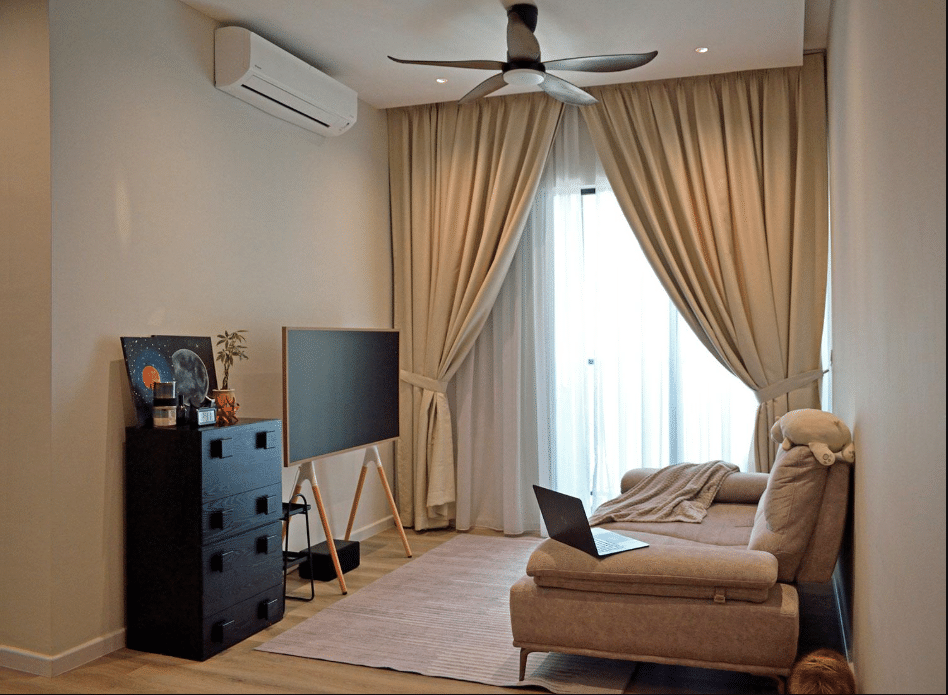
“We’re very satisfied with GGE’s work. They delivered on time, maintained cleanliness throughout the renovation, and handled everything professionally.”
— Kah Seng, homeowner
View Bintang Residence full gallery
These outcomes — no rework called out, clear day-to-day communication, delivery on schedule — are the practical result of design and quotation happening in the right order, not a one-off.
Green Flags and Red Flags to Watch For
Not every affordable contractor is a bad one — there are good, efficient tradespeople who deliver solid work at fair prices. The real warning signs aren’t about price; they’re about behaviour and process.
| Green Flag | Red Flag |
| Detailed, item-by-item quote with material specs | One lump-sum quote, no breakdown |
| Named material brands and grades | Vague terms like “standard quality” |
| Written contract with warranty terms | Verbal agreement or a one-page invoice |
| Portfolio of completed, similar projects | No verifiable past work, just stock photos |
| Payments tied to project milestones | Demands a large lump sum upfront |
Table 3 — A quick checklist before you sign anything.
How GGE Prices a Project
Separating design from construction doesn’t mean paying twice — it means paying for two different things at the right time. The design fee covers understanding the space, working through layout options, and solving problems on paper before they become expensive to fix on site. Only once that design is finalised does the renovation quotation get prepared, based on a confirmed scope rather than an early guess.
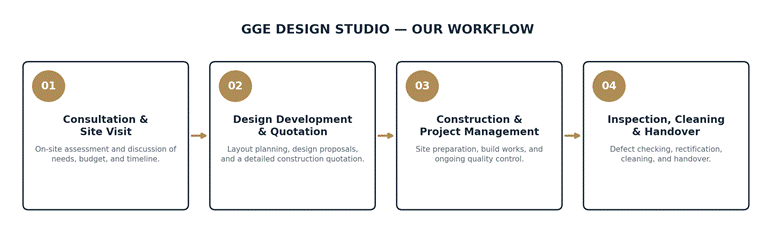
A quote can only genuinely be called “fixed-price” once four things are true: the design is completed, the scope of work is finalised, material specifications are confirmed, and construction methods are defined. A number handed over before those are locked in is an estimate dressed up as a fixed price — it will move once the real details get filled in during construction.
Why This Matters More for Commercial Spaces
For homeowners, a bad renovation is painful. For business owners, it can be existential. A retail space with poor foot traffic flow loses sales; an office with bad lighting and acoustics measurably hurts productivity; a restaurant with the wrong atmosphere loses repeat customers before the food arrives. The cheapest commercial fit-out rarely stays the cheapest once lost revenue and early refurbishment are counted in.
Japanese-style restaurant design — raw timber, textured plaster, spaces that feel intimate rather than cramped — tends to need only a light refresh every five to seven years, instead of a full overhaul every two, because the materials and detailing were chosen to last from the start.
The One Question That Changes Everything
Before signing any renovation contract — home or business — the real question isn’t “how much does this cost?” It’s “how much will this actually cost me?” The first question is about the invoice. The second is about everything that comes after: living with it, maintaining it, fixing it, and eventually selling or handing it over.
Going cheap isn’t automatically a bad idea. The problem is when “cheap” actually means under-specified, under-supervised, and undocumented — because that’s what quietly turns into a bigger bill later, usually at the worst possible time.
Ready to Renovate Right — the First Time?
GGE Design Studio is a Malaysian interior design practice working across residential and commercial spaces, with particular depth in minimalist and Japanese-influenced design. If you’ve received a quote that seems too good to be true, or just want a second opinion before committing to anything, the first conversation doesn’t cost anything.
Talk to GGE first: ggedesignstudio.com