
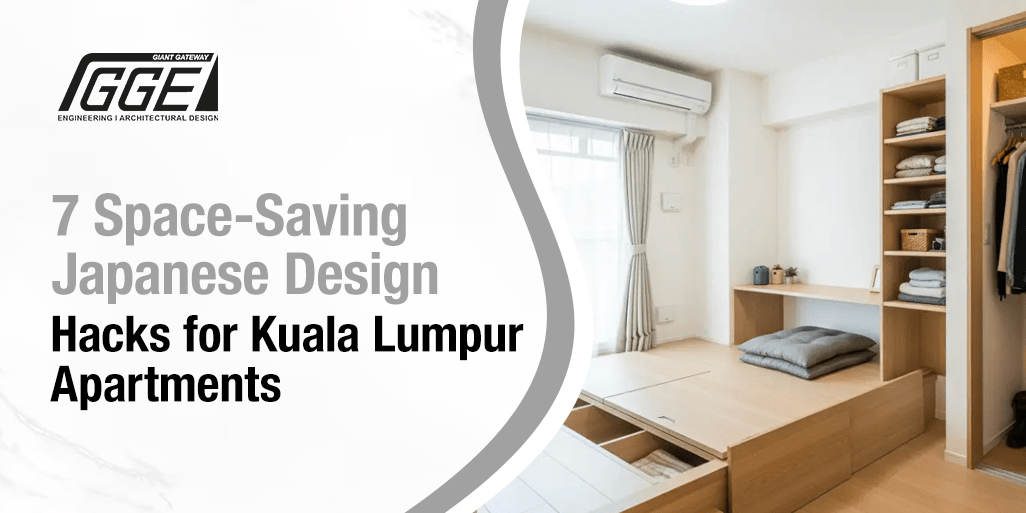
Japanese interior design for apartments starts with how you use the space: where belongings are stored, how people move between rooms and which areas need privacy. In a Malaysian condo, the design also needs to account for daylight, cooking habits, moisture exposure and renovation restrictions.
These seven ideas show how storage, flexible partitions, furniture and lighting can make a compact home more practical. The aim is to create a layout that supports everyday living while retaining the calm and clarity associated with Japanese interiors.
1. The Modern Tansu: Hidden Storage for the Urban Nomad
In traditional Japanese homes, a Tansu was a mobile cabinetry unit used for everything from clothes to kitchenware. In a Japanese-inspired apartment in Bangsar, this can become integrated storage planned around the homeowner’s belongings and daily routines. Think of a hallway wall that looks like a seamless wood panel but opens to reveal a pantry, a vacuum station, or a hidden home office.
The trick is to eliminate visual noise. When everything has a place behind a closed, flush door, the brain perceives the room as larger. In many luxury developments, we are seeing a move away from bulky, freestanding wardrobes in favour of these integrated systems. By utilising full vertical height—literally from floor to ceiling—you reclaim the “dead space” that most people ignore.
2. The Power of the Platform: Sleeping Above the Clutter
One of the most effective ways to add square footage without actually moving walls is to change your elevation. Platform beds are a staple of Japanese interior design in Malaysia because they serve a dual purpose. By raising the bed just 15 to 20 inches off the floor, you create a massive “basement” in your bedroom. Check the remaining ceiling height, access to drawers and how easily you can get in and out of bed. A raised platform will not suit every household, particularly where step-free access or easy cleaning beneath furniture is a priority.
Imagine deep, soft-close drawers that pull out to hold your entire winter wardrobe (for those occasional trips to Genting or overseas) or bulky sports equipment. According to a study by the Council on Tall Buildings and Urban Habitat, as urban density increases, the internal efficiency of living space becomes the primary driver of property value. A well-engineered platform bed isn’t just a place to sleep; it’s a high-efficiency storage warehouse.
3. Light Without Borders: The Shoji and Glass Shift
The biggest mistake people make in small studio units is using solid walls to create “rooms.” In a climate like Malaysia’s, you want light to penetrate as deep into the unit as possible. Traditional Shoji screens used translucent paper, but for the modern KL condo, we use frosted glass or fluted acrylic panels set in slim timber frames.
These sliding doors allow you to wall off the bedroom when guests come over without turning your living area into a dark cave. When they are open, the entire apartment feels like one continuous, breezy hall. In an apartment, a sliding partition can separate a sleeping or working area while preserving flexibility. Its position should suit furniture access, privacy and the available opening width.
4. The Genkan Philosophy: The Clean Transition
Every Malaysian home understands the “no shoes inside” rule, but we rarely design for it properly. The Japanese Genkan is a dedicated entry zone that sits slightly lower than the rest of the house. While you can’t always lower your floor in a high-rise, you can create a “visual Genkan” using different flooring materials—perhaps a durable slate tile that transitions into warm oak planks.
This hack isn’t just about cleanliness; it’s a mental reset. It’s the space where you shed the stress of the Federal Highway before entering your sanctuary. By incorporating a slim, built-in bench and recessed shoe cubbies, you prevent the “shoe mountain” that usually plagues the front door of KL apartments.
| Design Hack | Traditional Concept | KL Urban Benefit |
| Integrated Tansu | Mobile Step-Chests | Zero visual clutter; utilises vertical wall space |
| Raised Platforms | Tatami Mats | Creates “hidden” square footage for storage |
| Sliding Dividers | Shoji Screens | Maintains natural light while providing privacy |
| Visual Genkan | Sunken Entrance | Organized entry; psychological “work-to-home” reset |
5. Multi-Functional “Transformer” Furniture
In a space-strapped apartment, every piece of furniture must have at least two jobs. A dining table may also serve as a workspace, while a bench can incorporate accessible storage. Choose furniture around the activities it needs to support rather than adding features that will rarely be used. A sofa can have integrated shelving in the armrests. This “all-in-one” approach is increasingly popular in restaurant interior design in Malaysia, where every square meter must contribute to the customer experience and the bottom line.
Think of it as the “Swiss Army Knife” of interior design. When you choose pieces that are scaled for smaller rooms—lower profiles, thinner legs, and lighter woods—the room feels much more expansive. Heavy, dark furniture is the enemy of the high-density condo.
6. Biophilic Accents: Bringing the “Outside” In
Japanese design is nothing without nature. Even in the middle of a concrete jungle like Mont Kiara, you can integrate greenery through vertical gardens or “indoor courtyards.” A small corner with white pebbles, a single specimen plant like a Bonsai or a Sansevieria, and a focused spotlight can create a focal point that draws the eye, making the walls feel further away.
Research published in the Journal of Physiological Anthropology suggests that active interaction with indoor plants can reduce physiological and psychological stress compared to mental work. In a high-pressure city like KL, these small “Zen pockets” are essential for mental health.
7. Strategic Reflection and Lighting
Finally, the use of light is a hack in itself. In Japanese design, light is meant to be soft and indirect. Instead of one harsh overhead light, use multiple “pools” of light. Recessed LED strips under cabinets or along the base of your platform bed can make the furniture appear to “float,” which lightens the visual weight of the room.
Pair this with strategic mirror placement. A mirror can reflect daylight and extend a view, but its position matters. Check glare, privacy and what it will reflect before committing to a large installation.
Ensuring that these complex internal modifications are structurally sound is paramount, especially when installing heavy platforms or removing non-load-bearing partitions. This is where the structural expertise of GGE Design Studio becomes an invaluable asset for homeowners.
The Intersection of Art and Engineering
When we look at the broader landscape of commercial interior design in Malaysia, the move toward Japanese-inspired minimalism is clear. It’s about efficiency, durability, and a quiet sense of luxury that doesn’t need to shout. It’s a design language that speaks to our desire for order in a chaotic world.
At Novum Bangsar, GGE planned kitchen storage and workflow to reduce clutter, alongside a custom easel with adjustable shelving. The project shows why useful storage starts with the homeowner’s activities and possessions, rather than a standard cabinet arrangement.
Whether you are looking for a total renovation or just a few clever hacks, the goal is to make your home work for you, not the other way around. By focusing on quality materials and intelligent layouts, you can live a “large” life in a small space.
For those ready to turn these concepts into a reality, GGE Design Studio offers the perfect blend of aesthetic mastery and technical precision. We don’t just design rooms; we engineer lifestyles that honour the traditions of the past while embracing the technology of the future.
Frequently Asked Questions
- Can Japanese design work with my existing furniture?
Absolutely. The key is to introduce “bridges.” For example, if you have a traditional sofa, you can “Japan-ify” the space by adding a low-profile wooden coffee table and replacing heavy curtains with light-filtering bamboo or fabric blinds.
- Are platform beds expensive to build in Malaysia?
The cost varies depending on the materials (solid wood vs. laminate) and the complexity of the storage. However, when you consider the cost of buying separate wardrobes and the “value” of the space you save, a platform bed is often a very smart investment for small apartments.
- Does GGE Design Studio handle small apartment renovations?
Yes, we specialise in high-impact urban renovations. We believe that small spaces require more design “intelligence” than large ones, and we take pride in creating bespoke solutions for KL’s high-density developments.

Start Your Transformation
Your apartment should be a reflection of your aspirations, not a limitation of your lifestyle. In the heart of Kuala Lumpur’s most vibrant neighbourhoods, we are helping residents reclaim their space and find their “Zen” through thoughtful, engineered design.
At GGE Design Studio, we bring together the finest architectural minds and interior specialists to ensure your renovation is seamless from the first sketch to the final coat of paint. We understand the unique challenges of Malaysian high-rise living and have the tools to solve them.
Planning a Japanese-inspired apartment renovation? Explore GGE’s residential interior design and renovation services, then share your floor plan, storage priorities and preferred style with our team.