
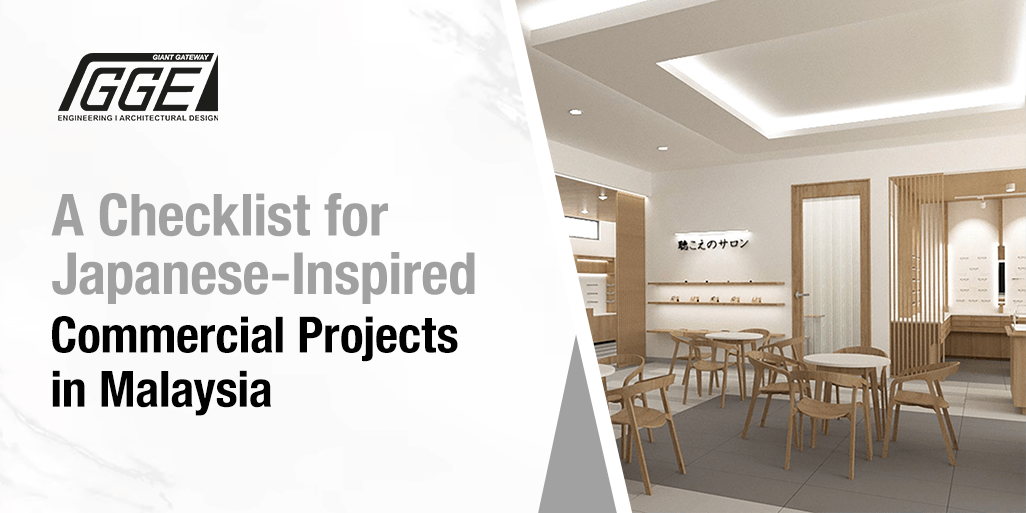
Opening a commercial space in Malaysia—whether it’s a boutique retail outlet in Mid Valley or a specialised Omakase haunt in George Town—is an exercise in patience and precision. When you add the specific requirements of Japanese minimalism into the mix, the complexity doubles. You aren’t just building a store; you are curating an atmosphere of “Zen” in one of the most vibrant, chaotic markets in Southeast Asia.
The success of a Japanese interior design in Malaysia project hinges on the “silent” details: the way the light hits a textured wall, the scent of the timber, and the seamless transition between the bustling street and the quiet interior. This guide serves as your strategic checklist for navigating the red tape, material sourcing, and aesthetic alignment necessary to bring the “Rising Sun” to the Malaysian tropics.
1. The Red Tape: Permits and Authority Submissions
Before you even think about the shade of your tatami mats, you must clear the hurdle of Malaysian bureaucracy. In 2026, the local councils (PBTs) like DBKL, MBPJ, and MBJB have moved toward more digital, rigorous submission processes.
For commercial projects, minor cosmetic changes might fly under the radar, but any structural alteration, changes to the fire safety systems (Bomba), or modifications to the building façade require a formal permit. According to Section 70 of the Street, Drainage and Building Act 1974, starting work without a permit can lead to stop-work orders and significant fines—sometimes exceeding RM10,000 (Source: Conzlab Berhad).
| Approval Type | Issuing Body | Average Timeline (2026) |
| Renovation Permit | Local Council (e.g., DBKL) | 2–4 Weeks |
| Fire Safety (Bomba) | Jabatan Bomba & Penyelamat | 3–6 Weeks |
| CCC (Completion) | Registered Architect/Engineer | Post-Construction |
2. The Sourcing Strategy: Japan vs. Local Timber
The most common question for a restaurant interior design project in Malaysia is: “Do we import the wood?” While Hinoki (Japanese Cypress) or Sugi (Cedar) offer an unmistakable scent and pale beauty, importing bulk timber is expensive. As of early 2026, customs export duties for transformed timber products have increased, with sawn timber taxed at 15% (Source: Fedemaderas).
The “Smart Strategist” approach is a 70/30 split. Use high-quality local timbers like Merbau or Rubberwood (treated for a lighter finish) for the structural elements and large surfaces. Reserve the imported Japanese timber for “touchpoints”—the sushi counter, the entry door handle, or the focal feature wall. This maintains the authentic sensory experience while keeping the budget grounded.
3. Finding the “Zen” in Your Contractor
Not every talented contractor understands the nuances of Japanese aesthetics. In Malaysia, where the “more is more” approach often dominates, a contractor who doesn’t understand “Ma” (negative space) will try to fill every corner.
You need a partner who understands that in commercial interior design services, the absence of an object is as important as the object itself. Look for portfolios that show clean joinery, hidden fixings (no visible screws), and an obsession with alignment. If the lines of the floorboards don’t align perfectly with the lines of the wall panels, the “Zen” is broken.
4. Lighting: The “In Praise of Shadows” Rule
In a mall environment, your biggest enemy is the harsh, overhead fluorescent glare. To achieve a Japanese aesthetic, you must control the lighting. This means layering:
- Ambient: Warm LED strips hidden in ceiling coves.
- Accent: Focused pin-spots on art or floral arrangements.
- Task: Clear, shadow-free light for the chef or cashier.
In 2026, smart lighting systems that adjust based on the time of day are becoming standard. This mimics the natural circadian rhythm, making customers stay longer and feel more relaxed.
5. Acoustic Engineering: The Sound of Silence
In high-density Malaysian malls, noise bleed is a constant battle. A premium Japanese restaurant or spa must be an acoustic sanctuary. This involves using “soft” minimalism—textured acoustic plaster that looks like raw concrete but absorbs sound, and decoupled wall structures that prevent vibrations from neighbouring units.
Achieving this level of technical isolation in a commercial unit requires more than just decor; it requires structural mastery. This is why many business owners consult with GGE Design Studio to ensure sound engineering principles and compliant with local building codes support their ambitious acoustic and aesthetic goals.
6. The “Genkan” and Flow: Managing the Transition
The entrance is your most important “conversion” tool. In Japanese design, the Genkan marks the shift from the profane (the street) to the sacred (the interior). Even in a retail setting, a small change in floor level or material—perhaps moving from mall tiles to a textured stone foyer—tells the customer’s brain to “slow down.”
This flow must be intuitive. If a customer has to wonder where to go or how to enter, the design has failed. The path should be a guided discovery, a principle that is just as effective in a Japanese home interior design as it is in a sprawling flagship store.
7. Sustainability and the 2026 “Green” Standard
Sustainability is no longer a luxury; it’s a requirement for many mall managements and conscious consumers. Use low-VOC finishes and FSC-certified timber. Japanese design inherently favours natural materials, which aligns perfectly with the shift toward “Green” commercial interiors.
A well-designed, sustainable space doesn’t just feel better; it performs better. Research indicates that biophilic elements—like indoor gardens and natural light—can boost occupant well-being and productivity significantly (Source: ResearchGate).
For projects that involve significant biophilic installations—such as internal water features or heavy stone gardens—the structural load must be calculated with extreme care. This technical oversight is a core strength of GGE Design Studio, providing peace of mind for business owners who want to push the boundaries of modern design safely.
8. Material Durability in the Tropics
Malaysia’s humidity is the natural enemy of fine woodwork. Ensure your contractor uses marine-grade adhesives and moisture-resistant treatments, even for indoor projects. Pure Japanese paper shoji screens are beautiful but won’t last in a high-traffic Malaysian mall. Use acrylic or frosted glass “shoji” instead—they provide the same aesthetic with ten times the durability.
9. Budgeting for the “Hidden” Costs
Always include a 15% contingency in your budget for “Authority Requirements.” You may find that Bomba requires an extra smoke extractor or that the mall management demands a specific type of fire-rated glass for your storefront. These are non-negotiable costs that can derail a project if not planned for.
10. The Final Handover: Rectification and Peace
The last 5% of a renovation is the hardest. In Japanese culture, the “finishing touch” is everything. Do not rush the final handover. Conduct a thorough walkthrough to check for “level and plumb” surfaces, smooth drawer runners, and perfect paint finishes.
Your commercial space is your brand’s physical embassy. By following this checklist and prioritising precision over speed, you create a destination that doesn’t just occupy space—it creates a legacy.
Frequently Asked Questions
- Do I really need Bomba approval for a simple shop renovation?
Yes, if you are adding partitions, changing the ceiling, or modifying the layout of the sprinklers and smoke detectors. Most malls will not allow you to open without a letter of clearance from Bomba.
- Is “Japandi” different from traditional Japanese design?
“Japandi” is a hybrid of Japanese minimalism and Scandinavian functionality. It often uses warmer tones and more “comfortable” furniture, making it very popular for Malaysian cafes and co-working spaces.
- How long does a typical 1,000 sq. ft. commercial renovation take?
Including the 4–8 weeks for permits and 8–12 weeks for construction, you should plan for a 4-to-5-month window from concept to opening.
- Can I use local bamboo instead of Japanese bamboo?
Absolutely. Malaysia has incredible local bamboo varieties that are well-suited to our climate. The key is in how it is cured and finished to achieve that refined Japanese look.

Your Vision, Engineered
Bringing a Japanese-inspired project to life in Malaysia is a journey of a thousand small, intentional steps. It requires a rare blend of creative vision and the technical “grit” to navigate local regulations and structural challenges.
At GGE Design Studio, we bridge that gap. We specialise in providing the high-level engineering and design coordination required for sophisticated commercial projects. We ensure that your “Zen” sanctuary is built on a foundation of absolute reliability and technical excellence.
Don’t leave your renovation to chance. Visit GGE Design Studio to see how we’ve helped businesses across Malaysia achieve world-class interior standards. Whether you’re launching a new flagship or refining a boutique space, we have the expertise to make it seamless. Contact GGE Design Studio today and let’s start building your future.