Japanese restaurant interior design should begin with the dining format. A ramen shop, family restaurant, izakaya and omakase counter have different requirements for seating, service speed, privacy and kitchen coordination. The design needs to support these differences before materials and decorative details are selected.
For restaurants in Malaysia, the next step is to coordinate the concept with the premises, customer movement, staff workflow and building requirements. Current design ideas can inform the atmosphere, but they should be tested against daily operations and maintenance.
Match the Interior to the Restaurant Format
| Format | Main planning priority | Design consideration |
|---|---|---|
| Ramen or quick-service shop | Ordering, collection and turnover | Clear routes and practical seating |
| Family Japanese restaurant | Groups and varied customer needs | Flexible tables and comfortable circulation |
| Izakaya | Social dining and atmosphere | Seating choices, acoustics and layered lighting |
| Omakase | Chef–guest interaction | Counter sightlines, working space and service access |
When a Dark Japanese Restaurant Interior Works
Dark finishes can suit intimate dining concepts, but they are one option. A family restaurant or daytime ramen shop may need a brighter environment. Test the lighting against menus, food presentation, changes in floor level and cleaning tasks before selecting a dark palette.
This shift toward “Dark Zen” serves a psychological purpose. In the overstimulated world of 2026, where we are bombarded by screens and neon, a dark restaurant acts as a sensory deprivation tank. It forces the diner to focus exclusively on two things: the person across from them and the artistry on the plate. This moody atmosphere is a far cry from the utilitarian look of a standard japanese home interior design, yet it borrows the same principles of minimalism and intention.
Materiality: Raw Concrete vs. Warm Pine
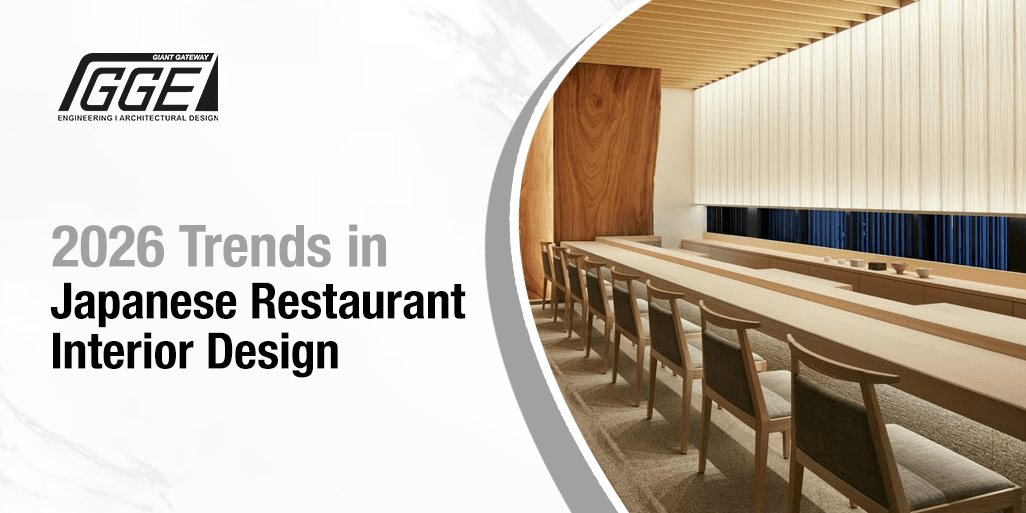
The tension between “hard” and “soft” materials is the defining characteristic of the 2026 aesthetic. We are seeing a fascinating juxtaposition of industrial raw concrete against the traditional warmth of Hinoki (cypress) or Pine wood.
In many high-end commercial interior design service projects, concrete is no longer seen as “unfinished.” Instead, it’s polished to a silk-like sheen or board-formed to show the grain of the wood used to cast it. When this cold, grey medium meets the honey-colored glow of a Hinoki sushi counter, the result is “Wabi-Sabi luxury”—the appreciation of the humble and the high-end existing in perfect harmony.
| Material | Aesthetic Feel | Functional Benefit |
| Concrete | Industrial, stoic, grounded | High durability, easy to clean, excellent thermal mass |
| Hinoki / Light Pine | Warm, organic, traditional | Natural antibacterial properties, pleasant scent |
| Charcoal Slate | Moody, sophisticated, raw | Masks wear and tear, provides high visual contrast |
| Washi Paper Glass | Ethereal, soft, diffused | Privacy without blocking light, mimics traditional screens |
The “Floating” Light: Integrated LED Innovation
Lighting in 2026 has moved away from the “object” (the lamp) to the “effect” (the glow). We are seeing a surge in integrated LED strips that are hidden behind joinery, under counters, or within ceiling coves. This creates a “floating” effect, making heavy stone counters appear weightless.
In an Omakase setting, the only bright light is often a surgical-grade pin spot directed at the chef’s hands. Everything else is bathed in a soft, amber hue. This isn’t just for drama; it’s about flattering the diner and the food. Statistics from the International Association of Lighting Designers suggest that appropriate “warmth” in lighting (between 2200K and 2700K) can increase stay time in hospitality venues by up to 18%, as guests feel more relaxed and less rushed.
The Silent Luxury: Acoustic Design in Busy Malls
One of the biggest challenges for Japanese interior design projects in Malaysia, located in mega-malls like Mid Valley or Pavilion, is the noise. There is nothing less “Zen” than hearing the muffled bass of a nearby cinema or the roar of a food court while you’re trying to enjoy a delicate piece of Otoro.
In 2026, acoustic engineering is the “invisible” luxury. Designers are now integrating sound-absorbing materials that don’t look like acoustic foam. Think fabric-wrapped ceiling baffles that look like architectural slats, or textured “liquid wallpaper” that eats echoes. A quiet restaurant in a loud mall feels like a miracle, and diners are willing to pay a premium for that silence.
For restaurant owners, ensuring these heavy acoustic treatments and stone finishes are safely integrated into mall units requires expert structural oversight. This is where the technical precision of GGE Design Studio becomes essential, bridging the gap between a beautiful concept and a safe, functional reality.
The Omakase Theatre: Beyond the Counter
Before finalising an omakase counter, coordinate guest sightlines, chef movement, service access and equipment requirements. Seating should support interaction without obstructing preparation or staff circulation. Any changes in floor level should be assessed for their practical implications.
This level of customisation is also trickling down into residential spaces. More Malaysians are requesting Japanese home interior design layouts that include a dedicated “tea room” or a miniature “chef’s counter” for hosting private dinners. The home is becoming an extension of the restaurant experience, focusing on high-quality materials like quartz and integrated induction hobs that disappear when not in use.
Sustainability and the “Life-Cycle” of Design
Sustainability in 2026 isn’t a buzzword; it’s a requirement. Modern Japanese restaurant design emphasises materials that age gracefully. Instead of cheap veneers that need replacing every three years, owners are investing in solid woods and natural stones that develop a “patina.”
According to a 2025 Global Sustainability Report, 62% of diners in the Asia-Pacific region prefer restaurants that demonstrate eco-conscious practices, including their choice of interior materials. By choosing Wabi-Sabi—which celebrates the beauty of age and imperfection—restaurateurs are actually creating more sustainable businesses.
Realising these complex, heavy-duty interiors in high-traffic commercial zones involves more than just picking furniture; it involves rigorous structural engineering. The team at GGE Design Studio provides the foundational expertise needed to execute these ambitious “Wabi-Sabi luxury” visions without compromising on safety or mall regulations.
The Importance of “Ma” (Negative Space)
Perhaps the most important trend for 2026 is the return of “Ma.” In a world where every inch of a mall is usually filled with kiosks and signage, Japanese restaurants are doing the opposite: they are leaving space empty.
An empty foyer with a single stone and a trickle of water tells the customer, “You can breathe now.” This use of negative space is a hallmark of premium commercial interior design services. It signals to the customer that the establishment is wealthy enough in spirit and space that they don’t need to “cram” every corner with a table.
Digital Integration: The “Invisible” Tech
While the aesthetic is ancient, the technology is 2026-fresh. We are seeing air purification systems hidden within wooden slats to ensure the air smells like fresh Hinoki, not fish. Hidden wireless charging pads are embedded directly into stone countertops, and QR codes for menus are subtly etched into small wooden blocks rather than printed on cheap stickers.
The technology is there to serve the peace, not to disrupt it. It’s about a “High-Tech, Low-Touch” philosophy that allows the staff to focus on hospitality while the environment takes care of the comfort.
Frequently Asked Questions
- What is the difference between Wabi-Sabi and traditional minimalism?
While minimalism seeks perfection and “less is more,” Wabi-Sabi finds beauty in “less is more… and it’s okay if it’s imperfect.” It embraces natural cracks in wood, the grain of stone, and the asymmetrical balance of nature.
- Is dark interior design suitable for small restaurant spaces?
Yes, if lit correctly. Dark colours can actually make walls “recede,” creating an illusion of depth. Using “floating” lights at the floor level can prevent the space from feeling claustrophobic.
- How long does a typical Japanese restaurant renovation take in Malaysia?
Depending on the complexity and mall approvals, a high-end fit-out usually takes 3 to 5 months. The procurement of specialised materials like Hinoki wood can sometimes add to the lead time.
- Can I get a Japanese-style Omakase kitchen in my own home?
Absolutely. Many residential clients are now adopting “Chef’s Table” styles for their dry kitchens, utilising professional-grade appliances hidden within minimalist Japanese cabinetry.

The Future is Intentional
The shift we are seeing in 2026 isn’t just about a change in “style”—it’s a change in the Malaysian dining soul. We are moving away from the loud and the fast toward the quiet and the meaningful. Whether it’s a restaurant in the heart of the city or a Japanese home interior design project, the goal is the same: to create a space that feels like an exhale.
At GGE Design Studio, we specialise in this intersection of heritage and modernity. We understand that a truly great space requires a balance of aesthetic bravery and structural integrity. From the weight of the concrete to the warmth of the light, we ensure every detail is engineered for perfection.
For project planning and execution, explore GGE’s commercial interior design services. You can also view Bashujiayan Intermark KL for an example of how a restaurant’s cultural identity informed its entrance, materials and overall atmosphere.