
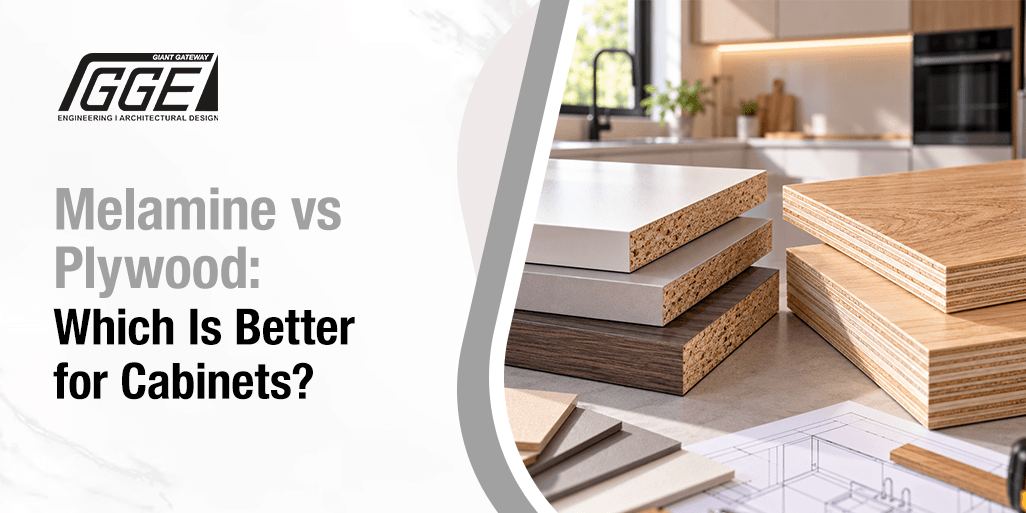
If you’ve ever run your hand across two cabinet door samples in a showroom — one smooth and matte, one grainy and warm — you already know this decision isn’t really about spec sheets. It’s about how you live in your kitchen, what you’re willing to spend, and how long it should look good before you’re staring at a swollen edge under the sink.
Here in Malaysia, there’s an extra variable most articles skip: heat and humidity. That changes the calculus more than most homeowners realise.
TL;DR — Quick Recommendation
- Tight budget, dry areas (pantries, wardrobes, upper cabinets): Melamine. Cheaper, huge colour range, fine as long as edges are sealed.
- Wet zones (sink base, under the hob, laundry, bathroom vanities): Plywood, or at minimum melamine with fully sealed edges.
- Renting or moving within 5 years: Melamine — no reason to pay for longevity you won’t use.
- Building a forever home: Plywood boxes with melamine or painted doors give you the best of both.
- Most real kitchens: Mix them. Plywood carcasses near water, melamine everywhere else. This is what GGE specifies on the majority of our residential projects.
- In Malaysia specifically: whichever material you choose, insist on E0 or E1-rated boards — our climate makes indoor air quality and moisture performance non-negotiable. More on this below.
Melamine vs Plywood at a Glance
| Factor | Melamine | Plywood |
| Core material | Particleboard or MDF | Layered wood veneer, cross-grained |
| Upfront cost | Lower | ~15–20% higher on average¹ |
| Moisture resistance | Good on the surface; weak at exposed/unsealed edges | Better overall; still not waterproof |
| Structural strength | Adequate for doors and panels | Stronger; preferred for cabinet boxes |
| Weight | Heavier per panel | Lighter, easier to install |
| Repairability | Hard to fix once chipped or swollen | Can be sanded, refinished, patched |
| Typical lifespan | 10–20 years with good care | Often 20+ years, especially for boxes |
| Aesthetic range | Huge — solid colours, wood-look prints, matte/gloss | Natural grain; needs finishing for colour |
Neither is objectively “better.” A busy family kitchen on a fixed budget and a high-end forever home will land on different answers — and both can be right.
What Each Material Actually Is
Melamine isn’t a wood type — it’s a finish. A resin-saturated decorative paper is bonded onto a particleboard or MDF core under heat and pressure, giving a hard, uniform, wipe-clean surface. Because the core is engineered and the panels arrive pre-finished, melamine typically runs 30–50% cheaper than solid wood, which is why it dominates budget renovations, rentals, and large multi-unit jobs. Its one real weakness: if water reaches the core through a chipped edge or an unsealed cut, it swells and doesn’t recover.
Plywood is thin layers of real wood veneer glued together with the grain of each layer running perpendicular to the next. That cross-graining is what resists warping and sagging, which is why cabinet boxes (the structural shell) are so often built from it even when the doors are melamine. It handles humidity more gracefully than particleboard, but it’s heavier, and because it usually needs paint, stain, or veneer finishing rather than arriving ready-made, it typically costs 15–20% more than a comparable melamine build.

Where GGE Sees This Play Out On Site
Over 20+ years of design-and-build work across Klang Valley homes, F&B outlets, and clinics — including projects for the Embassy of Japan, Sushi King, and several chiropractic and medical fit-outs — we’ve specified both materials more times than we can count, and the pattern is consistent: the failures are seldom about melamine vs plywood as materials. They’re about edges left unsealed and boards chosen without checking the emission grade.
On residential jobs, our default is plywood carcasses in sink bases, under the hob, and in bathroom vanities, with melamine doors and drawer fronts everywhere else — the approach we outline further on our Japanese Home Interior Design service page. You can see how this plays out across finished projects in our portfolio.
Want a second opinion on your own floor plan before you commit to a material? Get in touch with GGE Design Studio for a free consultation — we’ll walk the space with you rather than guess from a spec sheet.
Malaysia-Specific Considerations
Humidity is the real deciding factor here, more than in temperate markets.
Malaysia’s average relative humidity sits well above what most cabinet materials are engineered and tested for in cooler climates, which means edge-sealing quality and board grade matter more here than the marketing on either material suggests. A cabinet that performs fine in a dry, air-conditioned showroom can behave very differently in a naturally ventilated kitchen or a coastal condo.
E0 / E1 board grades matter as much as the material itself.
n the panel industry, formaldehyde-based resins are used to bind particleboard, MDF, and some plywood together, and boards are graded by how much they off-gas. E1 is generally the accepted minimum for enclosed indoor use, while E0 (and increasingly “Super E0”) is the lower-emission standard now offered by several Malaysian suppliers. This sits alongside international benchmarks like CARB Phase 2 and TSCA Title VI that some imported boards are certified to. Whichever material you choose — melamine or plywood — ask your contractor for the board’s emission grade and certificate. If they can’t produce one, treat that as a red flag.
Local practice that actually works.
PVC or ABS edge-banding on every cut edge, full sealing around sink bases and dishwasher cutouts, and choosing plywood (not particleboard) for anything within splash range of water. This is standard practice on GGE’s own projects and is the single biggest factor separating a cabinet that lasts 15 years from one that swells in two.
The Four-Question Framework
- Where is the cabinet going? Under a sink, next to a dishwasher, or in a laundry area — go plywood, or seal melamine edges properly. Pantries, closets, and upper cabinets are forgiving for melamine.
- What’s your real budget ceiling? If plywood forces cuts elsewhere (hardware, countertops, lighting), a well-made melamine cabinet with sealed edges will usually outperform a cheap plywood cabinet with rushed joinery. Quality within a category matters more than the category itself.
- How long will you stay? Renting or planning to move in five years — melamine’s lower cost wins. Building your forever kitchen — plywood’s repairability earns back the premium over time.
- What look are you going for? Melamine gives near-unlimited colour and finish options with a factory-consistent surface. Plywood gives you real grain, natural variation, and warmth a printed surface can’t fully replicate.
Where Japanese-Inspired Design Fits In
One thing we notice constantly on our Japanese-influenced residential projects: material choice ends up being a design statement as much as a construction decision. The calm, uncluttered look associated with Japanese interiors — low-contrast palettes, natural texture, nothing shouting for attention — tends to favour light plywood or oak-veneer finishes over high-gloss melamine, simply because visible grain does more of the quiet, tactile work that the style depends on.
In practice, though, we rarely build a Japanese-inspired home entirely in one material. A more common brief we get is plywood for open shelving and structural boxes, paired with matte melamine in muted greys, off-whites, or warm taupe for the lower cabinets that take the daily wear. The material follows the feeling the room is going for — it isn’t a rule that plywood always wins for this look.
Two Kitchens, Two Outcomes
A family renovating a 1990s kitchen on a MYR 12,000-equivalent budget chose full melamine with proper edge banding and PVC sealing around the sink base. Four years on, the cabinets still look close to new, aside from minor scuffing near the trash pull-out.
A coastal home with high ambient humidity used budget plywood without adequate sealing or finish coats. Within two years, several doors near an exterior wall began to cup. The issue wasn’t the plywood — it was skipping the finishing step plywood specifically needs to perform as advertised. Installation quality and finishing routinely matter more than the raw material choice.
FAQ
Is melamine or plywood better for kitchen cabinets?
It depends on placement and budget. Plywood generally handles moisture and structural stress better, making it the stronger choice for boxes and areas near sinks or dishwashers. Melamine is more budget-friendly and performs well for doors, dry storage, and upper cabinets when edges are properly sealed.
How long do melamine cabinets actually last?
Typically 10–20 years with proper care and installation². Lifespan shortens significantly if the core is repeatedly exposed to standing water.
Can plywood cabinets get wet?
Plywood isn’t waterproof, but its cross-layered construction resists swelling and warping better than particleboard. It still needs a proper finish or seal to hold up long-term in wet zones.
Is melamine bad for indoor air quality?
Some melamine boards use formaldehyde-based resins that can release low levels of VOCs, especially in cheaper, unsealed panels. In Malaysia, look for E0 or E1-certified boards, or international equivalents like CARB Phase 2, if indoor air quality is a concern.
Which material is easier to repair if damaged?
Plywood. A scratch, dent, or water mark can often be sanded and refinished. Melamine’s resin surface can’t be sanded the same way — once it chips, replacement is usually the only fix.
Is plywood always the more expensive option?
Almost always — typically 15–20% more than a comparable melamine cabinet, mostly due to material and finishing labour. Higher-grade melamine can sometimes close that gap.
The Bottom Line
There’s no universal winner — just the right material for your kitchen, budget, and climate. As a rule of thumb: build structural boxes and anything near water in plywood, and let melamine handle doors, drawer fronts, and dry storage where its cost savings and colour range get to shine. In Malaysia, insist on E0/E1-rated boards regardless of which material you pick.
Planning a renovation and want someone to walk your actual floor plan with you instead of guessing from a spec sheet? The team at GGE Design Studio specialises in exactly this kind of material and layout planning — from moisture-prone kitchens to Japanese-inspired minimalist interiors. Browse our portfolio, read more on our blog, or contact us for a free consultation.